
Choosing dog toys starts with what your dog actually enjoys: chasing, pulling, chewing, carrying, or solving problems. Match that behavior with an appropriate size and material, then supervise play and replace damaged toys. This guide explains how to choose the right toys for your dog without mistaking a loud squeaker, tough-looking surface, or complicated puzzle for a good fit.
How do you choose dog toys for your dog’s play style?
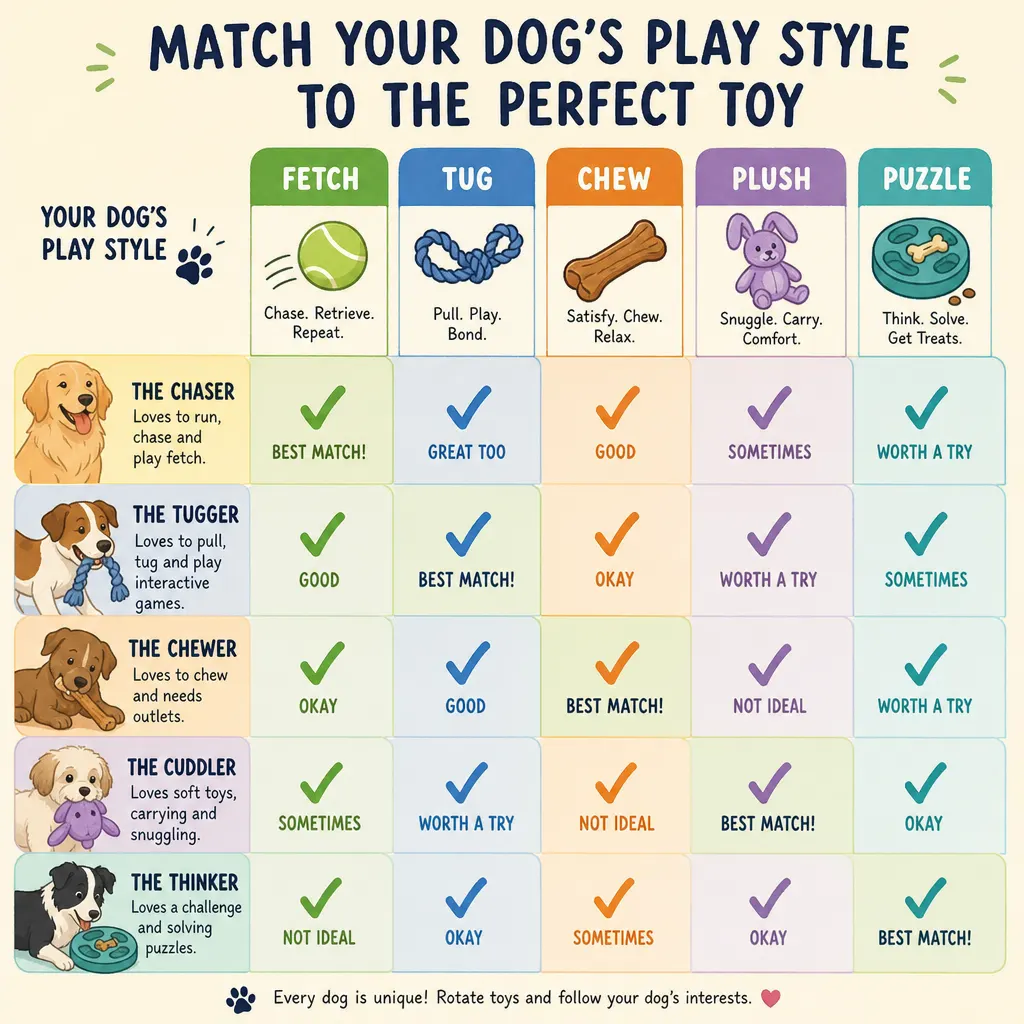
Choose toys around your dog’s observed behavior, mouth size, age, and chewing habits—not appearance alone. A dog that gently carries a stuffed animal needs a different design from one that immediately tears at seams. Appropriate dog toys for different play styles should support the activity while limiting opportunities to swallow pieces. (americanhumane.org)
Before buying, try this observation exercise during supervised play:
- Chases moving objects: Start with a correctly sized rubber ball or flexible retrieving toy.
- Brings toys to people: Try an interactive game of fetch or gentle tug.
- Settles down to gnaw: Compare purpose-made chew toys rather than assuming any sturdy toy is chewable.
- Carries without shredding: Consider simple plush toys without easily detached decorations.
- Works persistently for food: Introduce an easy food puzzle with accessible rewards.
Use those observations as a starting point, not a permanent label. Try one suitable toy first and note whether your dog uses it as intended before buying several similar ones.
Match the toy to the game
Fetch toys for dogs that love to run
The best fetch toys for dogs that love to run are appropriately sized, comfortable to retrieve, and suited to your play space. Rubber retrieving toys are a useful starting point; flexible discs offer another option for dogs that enjoy chasing. A fetch toy still needs inspection, especially if your dog stops retrieving and starts dismantling it.
When comparing outdoor toys for dogs, prioritize visibility and easy cleaning alongside shape. A toy that disappears into long grass or traps mud in inaccessible seams is less convenient for regular use. Choose outdoor dog toys with clear care instructions, and follow them after muddy games.
For dog toys for active and energetic dogs, plan the activity as carefully as the purchase. Start with short, manageable retrieves rather than making every throw a maximum-distance sprint. Think of dog exercise toys as equipment for shared play, not a requirement to keep throwing until your dog is exhausted.
Tug toys for dogs that enjoy teamwork
Tug toys for dogs should give you a comfortable grip and enough distance between your hand and your dog’s mouth. Long braided fleece and rope designs can work for interactive sessions, but they should be put away afterward if your dog shreds or eats fabric. A tug toy is not automatically an appropriate solo chew.
Keep movements gentle and side to side, without sharp jerks. Practice exchanging the toy: offer another appealing toy, notice when your dog releases the first, and gradually pair that action with a “give” cue. These games let training dog toys serve a practical purpose beyond burning energy.
For your first session, focus on comfortable handling and easy exchanges rather than a long contest. Choose a different activity if keeping hands clear proves difficult.
Soft dog toys for gentle carriers
Soft dog toys can suit dogs that enjoy carrying, cuddling, or gentle indoor play. Look for a simple shape without removable eyes, ribbons, or other tempting attachments. If your dog consistently tears open stuffed toys, choose another category rather than repeatedly replacing the same unsuitable design. (vcahospitals.com)
Watch the difference between carrying and picking apart. A toy that works during a gentle game may become unsuitable when your dog settles down to pull at its seams. Judge suitability by what happens during use, not by how carefully the toy was handled yesterday.
Chew toys for dogs that prefer gnawing
Chew toys for dogs need a balance of resilience and flexibility. Hardness alone is not a safety feature: veterinary guidance recommends avoiding objects that cannot bend or take a fingernail indentation because excessively hard items can damage teeth. Rubber also needs monitoring, since determined dogs may bite off chunks. (vcahospitals.com)
When comparing toys for aggressive chewers, examine the whole design. Prefer uncomplicated shapes without small protruding pieces, and check whether the manufacturer identifies the intended chewing level. “Durable dog toys” is a description to evaluate against your dog’s behavior, not permission to stop supervising. (vcahospitals.com)
The best dog toys for aggressive chewers are not necessarily the hardest ones. Your shortlist should prioritize appropriate size, some material give, and a design your dog does not immediately dismantle. If every option breaks apart quickly, ask your veterinarian for individualized guidance.
Are squeaky dog toys right for your dog?
Squeaky dog toys can be appropriate when your dog enjoys them without tearing through the exterior or trying to swallow the squeaker. They require close supervision because an exposed internal squeaker can become a choking or intestinal blockage hazard. Dogs that repeatedly destroy stuffed squeaky toys may need a different toy type.
Choose the construction around the game. A plush squeaker may suit a gentle carrier, while a purpose-made rubber squeaky ball offers a different option for supervised retrieving. Neither material makes the internal component harmless if your dog reaches it. Check that the size remains appropriate for your dog’s mouth.
Use this supervised trial when introducing squeaky toys for dogs:
- Offer the toy while you can watch the entire interaction.
- Observe whether your dog carries, retrieves, or immediately tears at it.
- Stop the game if seams open, rubber splits, or the squeaker becomes accessible.
- Retire the damaged toy rather than returning it with exposed components. (akc.org)
If the sound appears unwelcome, offer a quiet alternative instead of repeatedly squeaking it near your dog. There is no need for every toy basket to include noise. Choose based on the response you see, and keep squeaky play interactive rather than treating it as unattended entertainment.
Put safety ahead of durability claims
Treat “indestructible dog toys” as marketing language, not a guarantee. No dog toy is indestructible, and even products designed for strong chewers require supervision and replacement when damaged. Safe toys for dogs depend on appropriate selection and continued monitoring—not just the label on the packaging.
Use this inspection checklist before and after play:
- Size: The toy should not fit easily and entirely inside your dog’s mouth.
- Attachments: Avoid loose eyes, ribbons, and other pieces that could detach.
- Surface: Check for cracks, missing chunks, sharp damage, or exposed filling.
- Fabric: Retire toys with open seams or fraying rope.
- Hardness: Avoid excessively hard chewing surfaces that could damage teeth.
Durable toys for large dogs must be sized for the individual dog, not selected from a breed photograph. Check the actual dimensions and intended use. A large retrieving toy may still be unsuitable for sustained chewing, so keep the distinction between a game toy and a chew toy clear.
Make inspection part of putting toys away, rather than waiting for visible destruction during the next game. If you think your dog swallowed a toy piece, promptly contact your veterinarian; do not assume the material will pass harmlessly. (earthrated.com)
Choose puppy toys for developing mouths
Dog toys for puppies should match both their current mouth size and their developing teeth. Safe chew toys for puppies generally have some bend or can be indented with a fingernail. Avoid extremely hard options such as bones, antlers, and hard nylon, which can fracture teeth. Supervise chewing even when the product is specifically marketed for puppies.
Start with a small selection rather than a large mixed bundle: an appropriately sized flexible chew, a gentle interactive toy, and an easy food toy. Introduce them separately so you can see how your puppy handles each one. Remove anything that starts breaking apart.
Recheck sizing as your puppy grows. When chewing targets shoes or furniture, redirect to an appropriate toy and reward engagement with it. That gives you a practical teaching routine rather than relying on the toy alone to solve unwanted chewing.
What makes a puzzle toy useful for mental stimulation?
The best puzzle toys for mental stimulation offer a challenge your dog can understand and solve. Start with easy access to food, then gradually increase difficulty as your dog learns the task. A complicated puzzle is not automatically better; successful introductions to food puzzles should be gradual and rewarding. (avsab.org)
Compare mental stimulation toys for dogs by the action they invite:
- Rolling or wobbling: Treat dispensing dog toys release food when moved.
- Searching: Foraging designs encourage your dog to locate hidden food.
- Licking: Suitable food-filled toys provide a different way to access a reward.
- Manipulating: Puzzle toys for dogs may require moving a part to uncover food.
For a first session, make the reward obvious and help demonstrate the movement if needed. If your dog starts chewing pieces off the device, stop using that product. Enrichment toys for dogs should provide an appropriate activity, not introduce detachable parts your dog tries to eat.
When choosing the best interactive toys for bored dogs, ask what you can realistically supervise and maintain. Check how food residue can be removed before buying. Follow the product’s cleaning instructions, and keep food choices appropriate to your dog’s dietary needs.
Build variety into everyday play
Use interactive dog toys as part of a varied routine rather than expecting one product to meet every need. Food toys, retrieving games, and shared play offer different activities. Rotating suitable toys can also give familiar items another turn without requiring a constant stream of purchases. (vcahospitals.com)
Try this flexible menu of dog playtime activities:
- Shared movement: Offer a manageable fetch or tug game while you participate.
- Food-based activity: Introduce an easy puzzle using suitable food.
- Gentle play: Offer a soft toy only if your dog handles it without dismantling it.
- Practice: Use a favorite interactive toy to rehearse giving and taking on cue. (akc.org)
Keep a brief note of what gets used, ignored, or damaged. Before buying another toy, change one variable: the texture, shape, game, or difficulty. That makes your next choice more deliberate and helps you avoid accumulating variations of a design that does not suit your dog.
Buy for the dog in front of you
Learning how to choose dog toys is less about finding a universal winner and more about making a thoughtful match. If Konicamart is on your shopping shortlist, use the same checklist there: intended activity, dimensions, material, detachable components, and care instructions. Leave out products whose descriptions do not answer your essential questions.
Start small, observe closely, and adjust your choices. The best dog toys are the ones that fit your dog’s play style and remain appropriate during actual use—not simply the ones with the boldest promises.