
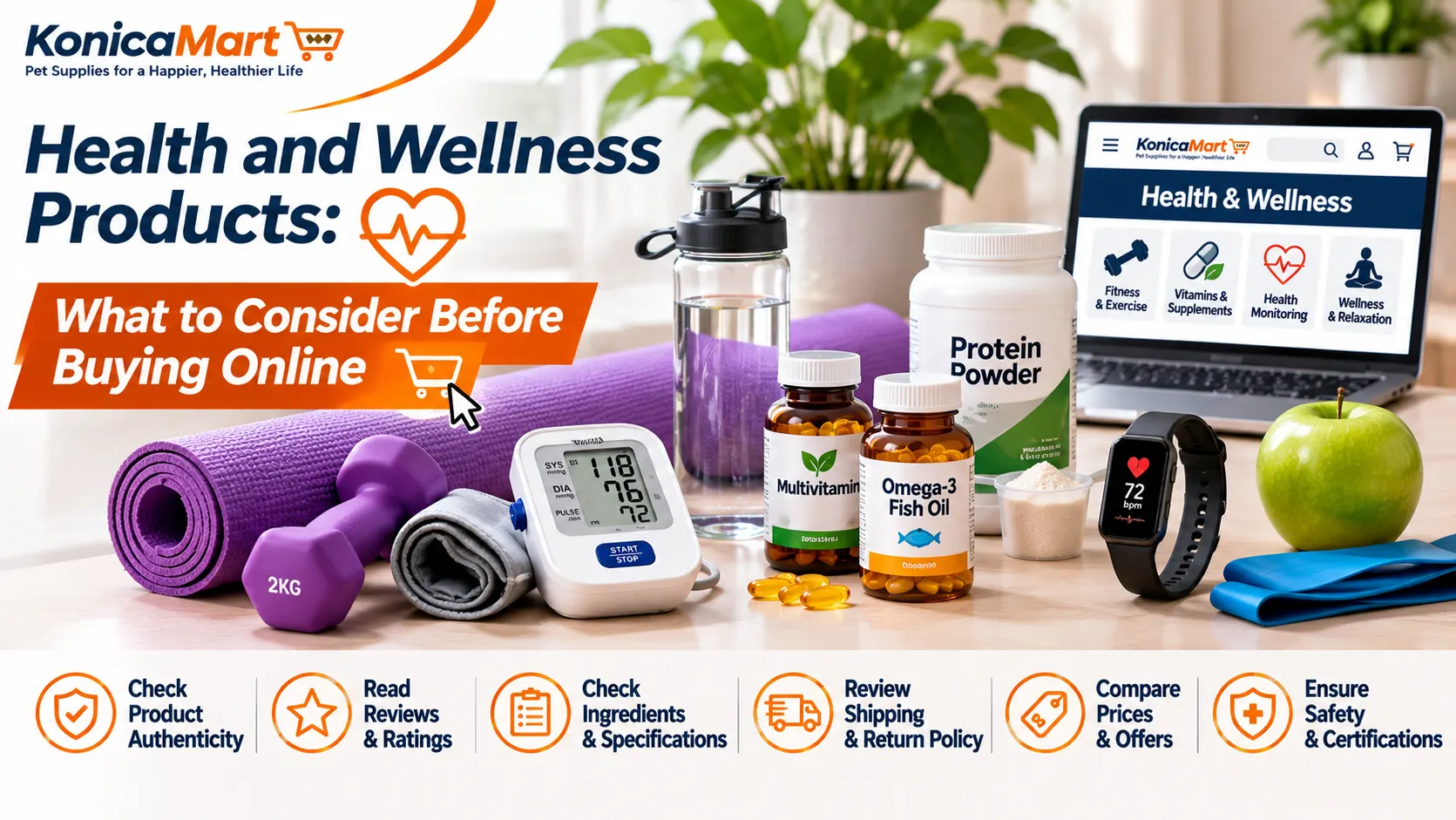
Buying health and wellness products online calls for two checks: whether the product suits your needs and whether the seller deserves your trust. Before paying, review the label, evidence behind health claims, full cost, and return terms. This guide explains what to consider before buying, whether you are browsing Konicamart or comparing another retailer.
What should you check before buying wellness products online?
Before buying wellness products online, check the product’s intended use, ingredients or materials, warnings, manufacturer, seller identity, and purchase conditions. For dietary supplements, also consider whether the product is appropriate alongside your medicines or existing health conditions. FDA advises discussing supplement use with a healthcare professional because these products can carry health risks.
Start with a clear purpose rather than an attractive offer. Are you replacing something you already use, looking for an exercise accessory, or considering a supplement recommended by a clinician? Write down the need before browsing so your comparison stays focused.
Use these questions to narrow your shortlist:
- Purpose: What specific task or routine will this product support?
- Suitability: Does the description match your intended user, setting, and use?
- Transparency: Can you inspect the label and instructions before paying?
- Practicality: Will you realistically use, clean, store, or replenish it?
- Uncertainty: What information would you need before feeling comfortable ordering?
Treat unanswered questions as reasons to investigate, not details to overlook because a sale is ending.
Match your checks to the product category
“Health and wellness” is a shopping category, not a single standard of evidence. An exercise mat needs a different evaluation from an herbal capsule. Organize your comparison around what the item does and how you will use it, rather than treating every wellness purchase alike.
For a mat or resistance band, make a practical checklist: dimensions, materials, care instructions, storage space, and any stated use limits. Compare those details with your available space and intended routine. If the listing leaves out a measurement that matters, ask before ordering rather than guessing from a photograph.
For a supplement, prioritize the full label, serving instructions, warnings, and suitability for you. Importantly, FDA does not approve dietary supplements for safety and effectiveness before they are marketed in the United States. Their presence in an online wellness store is therefore not evidence of FDA approval.
Keep your shortlist category-specific. A polished storefront should not replace close inspection of the individual product you plan to buy.
Read the complete label, not just the headline
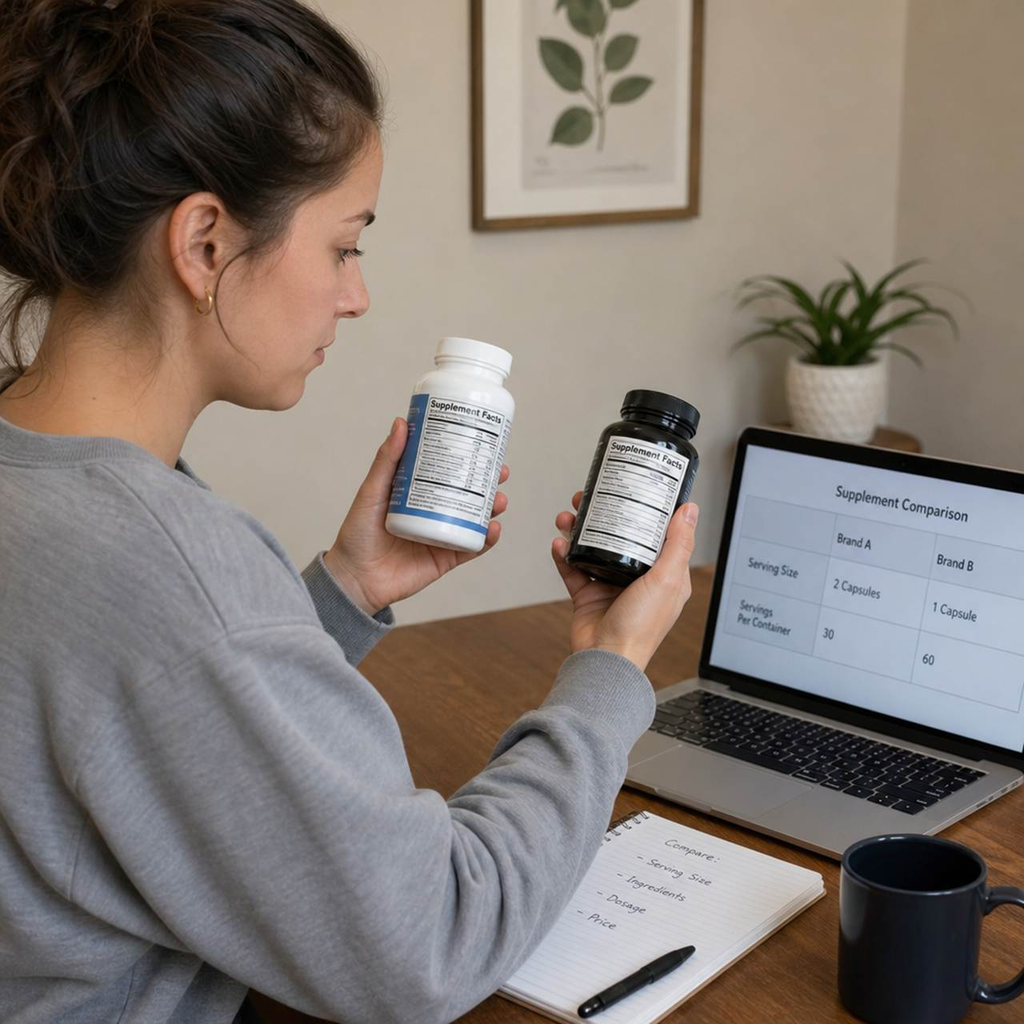
For supplements, inspect the Supplement Facts panel, serving size, servings per container, dietary ingredients, and “Other Ingredients” list. FDA’s labeling guidance explains that ingredient amounts are generally declared per serving, although individual amounts within proprietary blends may not be disclosed. Read the panel itself rather than relying on front-label numbers.
For example, a bottle containing 60 capsules is not necessarily a 60-serving purchase. Check how many capsules make up one serving before comparing it with another bottle. Also inspect the complete ingredient list for anything you need to avoid, rather than assuming the featured ingredient tells the whole story.
If an image is too small to read, request a clearer copy. You can also ask the manufacturer for information missing from the retailer’s description. FDA recommends contacting manufacturers when you need more detail about a supplement than its label provides.
For non-ingestible products, apply the same habit to materials, dimensions, cleaning instructions, and intended use. Build your decision from readable details, not packaging design.
How can you tell whether a health claim is credible?
A credible health claim needs relevant scientific evidence, not just enthusiastic testimonials or scientific-sounding language. The FTC’s guidance calls for health-related advertising claims to be supported by competent and reliable scientific evidence. That evidence should fit the specific product and the benefit being advertised.
When a listing mentions research, look beyond the existence of a citation. Ask whether the study examined the actual product, a comparable formulation, or only one ingredient. Check whether the research addresses the claimed outcome and people similar to the intended users. Research on an ingredient does not automatically establish that every finished product containing it delivers the same result.
Be especially cautious about sweeping promises: one product addressing many unrelated conditions, guaranteed results, or claims that sound like prescription-drug alternatives. FDA identifies unproven treatment claims and products promoted as alternatives to approved drugs among its health-fraud concerns.
A useful buying rule is to pause whenever the promise is clearer than the supporting evidence. Ask for the research, read its limitations, and leave the item off your shortlist if the explanation remains vague.
Check the seller separately from the product
A product you recognize does not remove the need to investigate the seller. Before sharing personal or payment information, confirm who operates the website and how to reach them. The FTC recommends checking an unfamiliar health-product seller’s physical address and telephone number and researching the business beyond its own pages.
For Konicamart or any retailer you are considering, use the same neutral standard. Find the contact information, read the policies, and ask a specific question if an important detail is missing. For instance, request confirmation of the exact product version or where a return would need to be sent.
Look for a response that answers your question directly. Save that reply with your order information if it influences your decision. Do not treat a friendly tone as a substitute for a clear answer about the item or transaction.
Also distinguish website security from seller reliability. An HTTPS address is worth checking, but the FTC cautions that security indicators alone are not foolproof evidence that a business is trustworthy.
Use reviews and testing claims for the right questions
Read customer reviews across several sources rather than relying on the star average displayed beside the purchase button. Consider who wrote each review, what experience they describe, and whether they received an incentive. The FTC warns that reviews and ratings can be fake or misleading, including both positive and negative feedback.
Use reviews to investigate practical questions. Did buyers receive the advertised size? Were instructions understandable? How did support respond when something went wrong? Treat personal reports of health improvements differently from these observations: testimonials do not replace scientific substantiation of a health claim.
For supplements, an independent quality-testing claim deserves a separate check. NIH’s Office of Dietary Supplements explains that testing organizations use different approaches, and quality seals do not guarantee that a product is safe or effective. Verify what the named organization actually assessed rather than reading a badge as a blanket endorsement.
Keep three questions separate: Is the seller dependable? Does the product meet stated quality criteria? Is there evidence for the benefit you want? One favorable answer cannot settle all three.
Compare real value and recurring commitments
Good wellness shopping online means comparing equivalent purchases. Record the exact size, model, quantity, or number of labeled servings, then add shipping and other checkout charges. The FTC recommends checking total cost and reading the terms of advertised deals rather than judging an offer by its headline price. (consumer.ftc.gov)
Create a small comparison note for each finalist:
- The exact product and package size you intend to order.
- The delivered total shown at checkout.
- Whether the purchase is one-time or recurring.
- Any accessories or replacement parts you would need.
- The unanswered questions that could change your decision.
For supplements, compare cost per labeled serving only after checking suitability; a lower serving cost is not a reason to take more. For equipment, decide whether the extra features serve your actual routine before paying for an upgrade.
Read subscription terms separately from product descriptions. Before accepting a trial or automatic delivery, find the future price, shipment schedule, cancellation method, and deadline. FTC consumer guidance recommends checking these details, watching for preselected boxes, and recording trial deadlines so recurring charges do not arrive unexpectedly. (consumer.ftc.gov)
When should you ask a healthcare professional first?
Ask a healthcare professional before choosing a supplement if you take medicines, have a medical condition, are pregnant or breastfeeding, are preparing for surgery, or are considering giving it to a child. Supplements may interact with medicines, and many have not been tested in pregnant people, nursing mothers, or children. Some can also affect bleeding or responses to anesthesia. (nccih.nih.gov)
Make that conversation useful by bringing the complete label, your intended reason for taking the product, and a list of medicines and supplements you already use. Instead of asking only whether a brand is “good,” ask whether that formulation and serving amount fit your circumstances. FDA recommends consulting a doctor, pharmacist, or other healthcare professional before purchasing or using a supplement.
Do not use online shopping as a substitute for assessing persistent or unexplained symptoms. NCCIH recommends discussing complementary approaches with your healthcare providers so decisions can be made together. If a supplement causes side effects, stop taking it and contact your healthcare provider.
Read the return terms before checkout
Before you shop health products, find out how the seller handles returns, refunds, delivery problems, and damaged orders. Read the policy for the exact category you are buying rather than assuming every item follows the same rules. FTC shopping guidance recommends reviewing delivery and refund terms and keeping purchase records.
Make a note of the return window, any stated condition requirements, who pays return shipping, and whether you need authorization before sending something back. If opening or using the item could affect eligibility, resolve that question before ordering. Save the listing and relevant correspondence alongside the receipt so you can refer to what was offered.
When the package arrives, compare it with your order before discarding the packaging. Check the product name, version, quantity, and visible condition. Photograph any discrepancy and ask the seller for written next steps before using an item that does not match what you expected.
Make the final decision with a short checklist
Keep health shopping online deliberate by reviewing the purchase once more outside the momentum of browsing. Open your shortlist, compare the unresolved details, and remove any item you cannot evaluate confidently. A discount should come after the decision that the product fits—not make that decision for you.
Before paying, confirm:
- Need: You can explain why you want this particular product.
- Details: You have read the relevant label or specifications.
- Evidence: You have separated advertising promises from support.
- Suitability: Any personal health questions have been addressed.
- Seller: You know whom to contact about the order.
- Commitment: You understand the total cost, renewals, and returns.
The aim is not to find the most impressive promise or the fullest shopping cart. It is to choose a product you understand, from a seller you have checked, on terms you are comfortable accepting. When important information is missing, waiting is a reasonable buying decision.